Counties in the Second Polish Republic and the Polish People’s Republic
Authors: Joanna Górska-Szymczak, Stanisław Górski
During the nearly two decades of the Second Polish Republic’s existence, only a limited number of changes were made to the number of counties (powiaty), although their territorial boundaries were modified somewhat more frequently. Ultimately, following adjustments to the administrative division of the state (including extensive changes to voivodeship boundaries introduced in early 1939), the Republic of Poland comprised 264 rural counties (powiaty ziemskie) and 23 municipal counties (powiaty grodzkie).
The reborn Polish state inherited not only a network of county-level territorial units whose origins dated back to the First Polish–Lithuanian Commonwealth, but also, at least initially, the models of county administration developed under the partitioning powers. As discussed in the previous chapter, in those states the fundamental institutions of county authority were governmental in character, although in Prussia and Austria they were complemented by elements of local self-government. These arrangements exerted a significant influence on the institutional shape of county administration in the Second Republic. Drawing on these inherited models, the authorities of the Republic introduced new regulations governing governmental administration at the county level. Similarly, the legal foundations and institutional position of county self-government were initially based on the legislation of the partitioning states 1 .
Only after several years was the system of territorial governmental administration unified under a single legal framework. These definitive arrangements were introduced by the Regulation of the President of the Republic of Poland of 19 January 1928 on the Organisation and Scope of Operation of the General Administrative Authorities 2 .
Under its provisions, the county governor (starosta) became the first-instance authority of governmental administration. Like the voivode, the starosta served as a representative of the central government and as the head of the general governmental administration within the county. Among his responsibilities was the coordination of governmental administrative activity at the county level in accordance with policies set by the central authorities. To this end, he was empowered to convene regular meetings of officials heading both integrated and non-integrated branches of administration operating within the county 3 .
The starosta also exercised supervisory authority 4 over the administrations of municipalities and communes located within his jurisdiction. A central duty of the starosta was the maintenance of public order and security. Accordingly, he was authorised to issue binding instructions and orders to units of the State Police in matters relating to public safety.
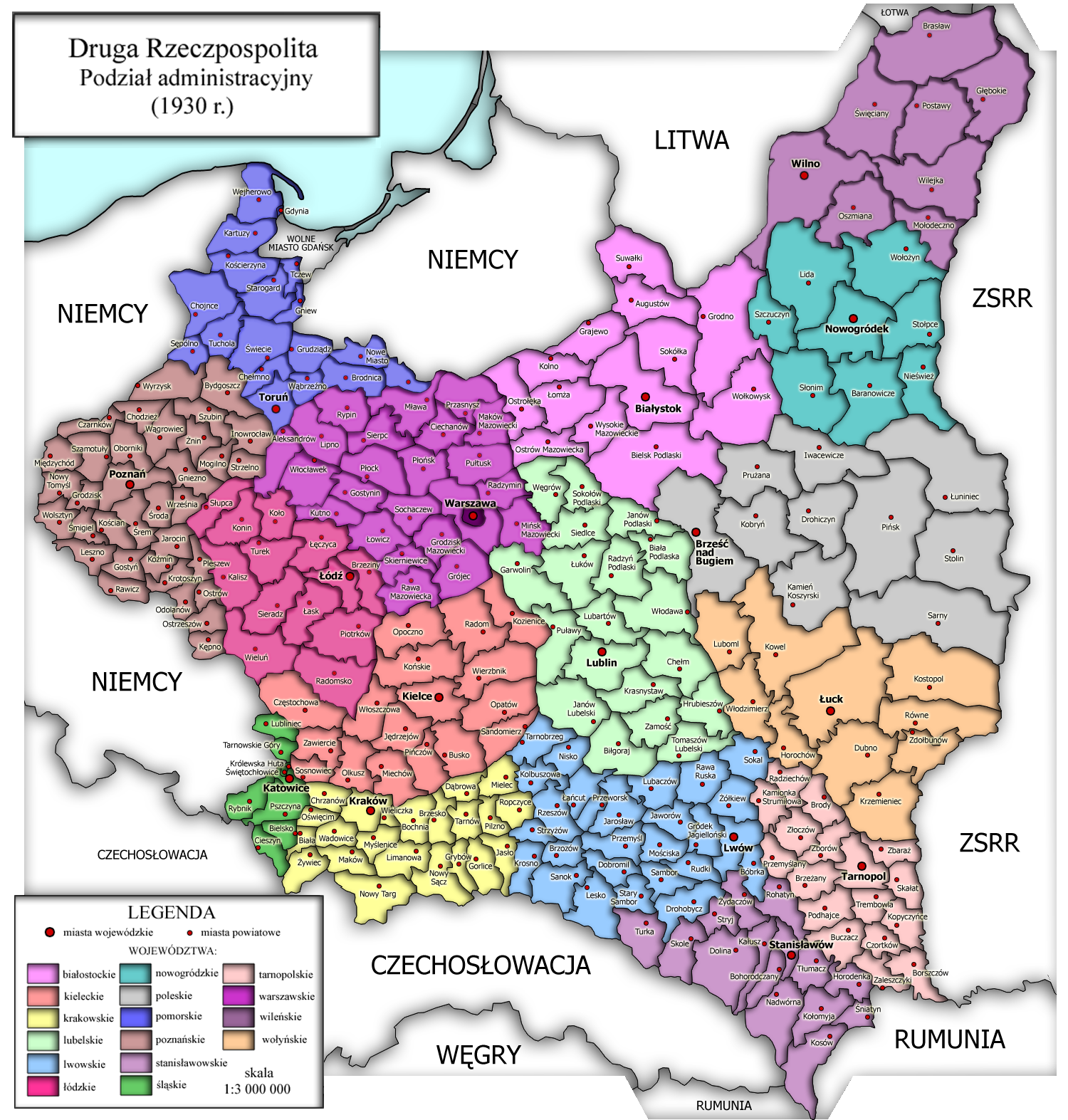
Figure 1. Administrative division of the Second Polish Republic in 1930. Source: Wikimedia Commons, Administrative division of the Second Polish Republic, https://commons.wiki- media.org/wiki/File:II_RP_adm.png [accessed on: 14.12.2025].
The starosta was appointed by the Minister of the Interior and was subordinated, in the performance of his duties, to the voivode.
His administrative apparatus was the county office (starostwo powiatowe). Its internal organisation was determined by the Minister of the Interior, in consultation with other ministers, and on this basis the voivode granted the office its statute 5 .
To facilitate access for the population, the Minister of the Interior could also establish branch offices of the county administration outside the seat of the starostwo. Within such branches, operating under the supervision of the starosta, specified administrative tasks could be carried out, including the issuance of decisions in the starosta’s name. This solution was applied in particular in the Eastern Borderlands (Kresy Wschodnie), where counties covered extensive territories with relatively low population density.
Cities with more than 75,000 inhabitants constituted municipal (urban) counties (powiaty grodzkie). In exceptional cases, municipal counties could also be created (by regulation of the Council of Ministers) in cities with smaller populations 6 .
The legal position of the municipal governor (starosta grodzki), who headed the governmental administration in such counties, was identical to that of a rural starosta. Municipal governors were appointed by the Minister of the Interior, who simultaneously conferred upon them, by regulation, the powers of a government representative.
In cities forming separate counties, these powers were transferred to the presidents (mayors) of the cities. Decisions of this kind were taken by the Council of Ministers, which also determined the scope of governmental administrative functions to be entrusted to the city president. This arrangement was intended to avoid a duplication of authority within urban centres.
In certain cases, the functions of a municipal governor were entrusted to the rural starosta whose seat was located in the same city 7 .
A distinct legal status was also granted to the rapidly developing port city of Gdynia, which was organised along lines similar to those applied in the capital, Warsaw, effectively enjoying the status of a separate voivodeship. In Gdynia, instead of a municipal governor, the office of Government Commissioner (Komisarz Rządu) was established8. His constitutional position closely resembled that of municipal governors in other large cities.
Until 1933, the organisation and functioning of county self-government continued to be governed by regulations inherited from the partitioning powers. In that year, as part of the first stage of a broader reform of local self-government, a new statute introduced fundamentally new solutions for county administration 9 .
Under this legislation, county self-government associations (powiatowe związki samorządowe) were established. These associations were endowed with deliberative bodies – the county councils (rady powiatowe) – and executive bodies – the county boards (wydziały powiatowe). County councils consisted of members of the county boards and councillors elected by electoral colleges. These colleges were composed of councillors and members of municipal and communal executive bodies operating within rural and urban communes not separated from the county. This institutional design effectively transformed the county into a self-governing association of the communes comprising it, since a substantial part of its composition resulted from indirect elections conducted by communal authorities.
Moreover, within the executive body – the county board – a specific fusion of governmental and self-governmental functions took place. The starosta and his deputy, who directed the board’s work, were appointed by the Minister of the Interior, while the remaining members were elected by the county council. In cities separated from counties, the functions of county authorities, otherwise exercised by county offices, were performed by municipal self-government bodies 10 .
As a result of a complex set of legislative measures redefining the legal foundations of public administration at the voivodeship and county levels, the boundaries of several voivodeships were revised and a number of counties reassigned. These changes were implemented at the turn of 1938 and 1939 and entered into force at the beginning of 1939. At that point, the final territorial structure of the Second Polish Republic was established (see the map below). This administrative arrangement, however, proved short-lived. Following the outbreak of the Second World War and the occupation of Polish territory by Nazi Germany and the Soviet Union, the existing division was rapidly dismantled through unlawful regulations imposed by the occupying powers 11 .
After the establishment in 1944 of communist authorities dependent on the Soviet Union and installed under the auspices of the Red Army 12 , one of the first decisions taken by the so-called Polish Committee of National Liberation was to restore the pre-war administrative division of the state.
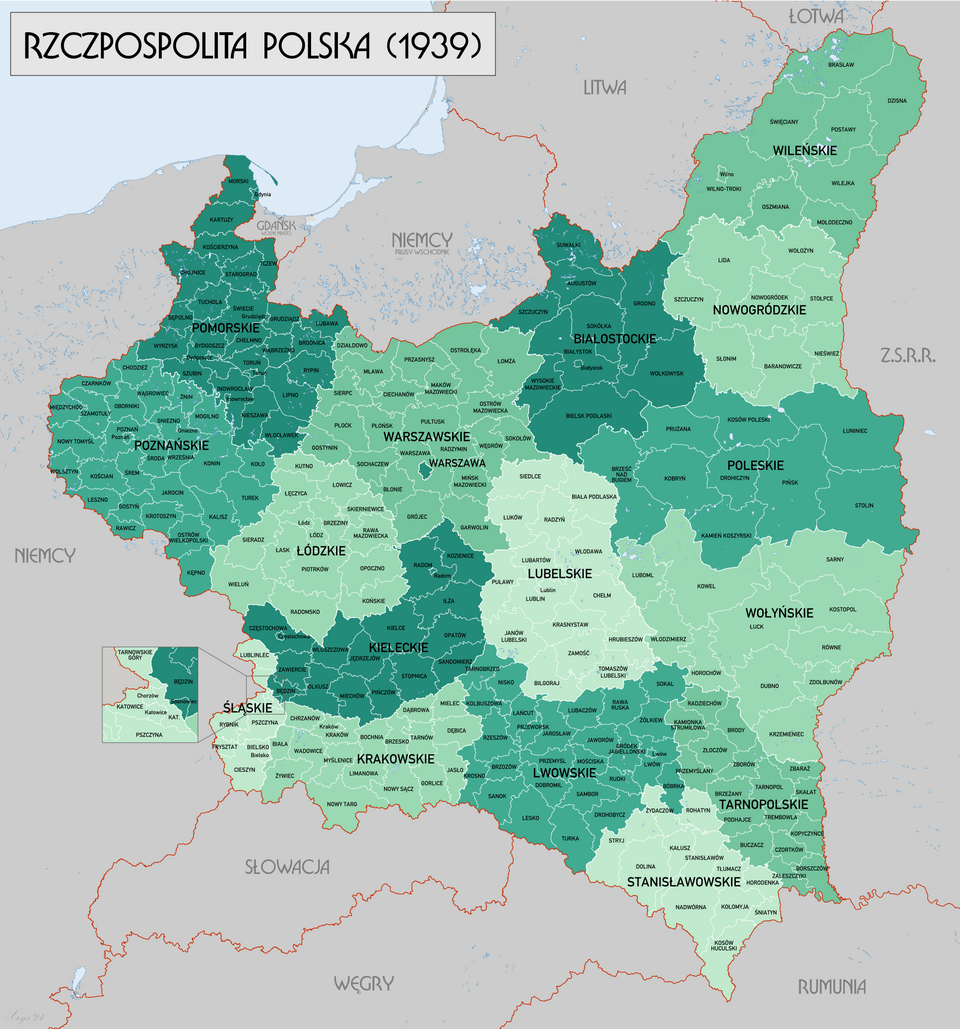
Figure 2. Administrative division of the Second Polish Republic in August 1939. Source: Wikimedia Commons, Administrative division of the Second Polish Republic, https://pl.wikipedia. org/wiki/Podzia%C5%82_administra- cyjny_II_Rzeczypospolitej#/media/ Plik:RzeczpospolitaPolska1939.png [accessed on: 14.12.2025].
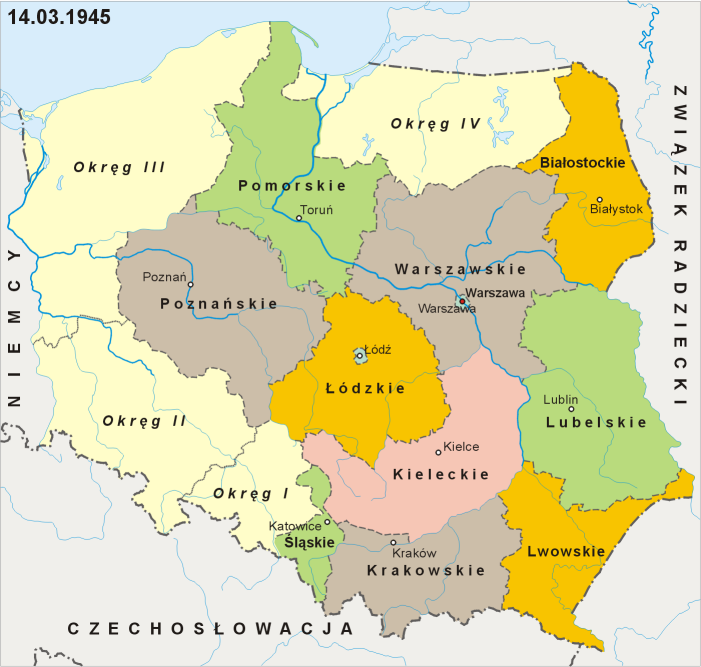
Figure 3. Administrative division of “Lublin Poland” in March 1945. The territories of the so-called Recovered Territories are marked on the map as “districts”.
Source: Wikimedia Commons, Administrative division of Poland as of 14 March 1945, https://pl.wikipedia.org/wiki/ Podzia%C5%82_administracyjny_ Polski_(1944%E2%80%931975)#/
media/Plik:POLSKA_14-03-1945.png [accessed on: 14.12.2025].
This restoration applied both to the modified number and territorial extent of voivodeships and to the structure of counties and municipalities. Accordingly, in areas gradually liberated from German control, counties were re-established within their pre-war boundaries.
By contrast, in territories that prior to 1 September 1939 had formed part of the German Reich (the so-called Recovered Territories, including Silesia, the Lubusz Land, Western Pomerania, Gdańsk, and Warmia and Masuria), a different approach was adopted. Alongside the initial creation of provisional “districts,” counties were established whose boundaries, in the vast majority of cases, corresponded to those of the former German counties.
As a consequence of these measures, a total of 294 counties were initially established within post-war Poland, including 29 urban counties. In the years that followed, the number of counties increased steadily, primarily as a result of progressive urbanisation, which affected urban counties in particular.
In June 1946, following the provisions of the Potsdam Conference 13 , it became possible to introduce a uniform territorial structure across the entire state.
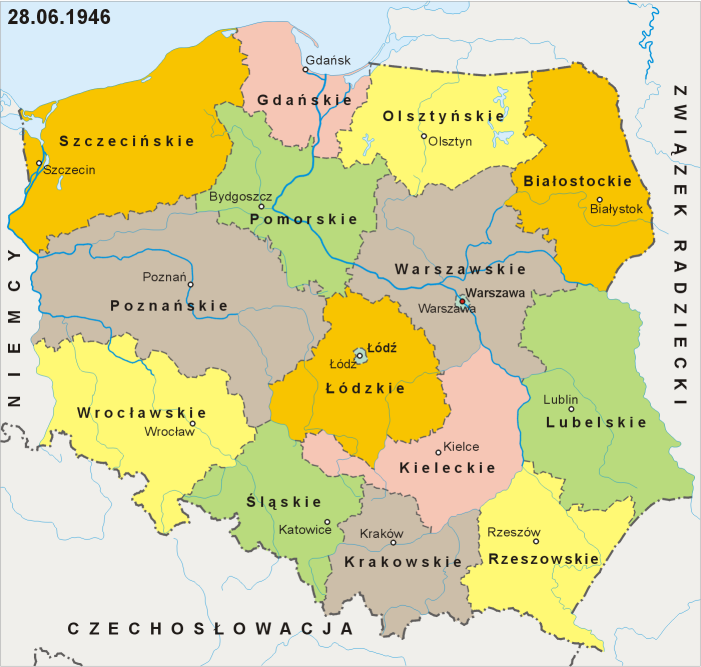
Figure 4. Administrative division of Polish territories into voivodeships in June 1946. Source: Wikimedia Commons, Administrative division of Poland, June 1946, https://pl.wikipedia.org/wiki/ Podzia%C5%82_administracyjny_ Polski_(1944%E2%80%931975)#/media/Plik:POLSKA_28-06-1946.png [accessed on: 14.12.2025].
A further reform of the administrative division was carried out in 1950 14 , the most significant element of which was the creation of three new voivodeships: Szczecin, Zielona Góra, and Opole. At that time, Poland consisted of 17 voivodeships, two cities with voivodeship status (Warsaw and Łódź), and 328 counties, including 57 urban counties.
The basic framework of Poland’s administrative division during the period of the so-called Polish People’s Republic (PRL) was consolidated in 1957 and remained largely unchanged until 1975. Under regulations adopted at the beginning of that year 15 , the cities of Kraków, Wrocław, and Poznań were also granted voivodeship status.
As a result of this sequence of changes in the territorial structure, at the time of the so-called administrative reform of 1975, which abolished the powiat as a level of the state’s administrative division, there were 392 powiats in existence, including 78 urban (city) powiats.
Following the reintroduction of counties in 1999, the overwhelming majority of counties that had existed prior to 1975 were restored. At present, Poland comprises 380 counties, including 66 cities with county status; notably, the number of rural counties (314) is identical to that recorded in 1975.
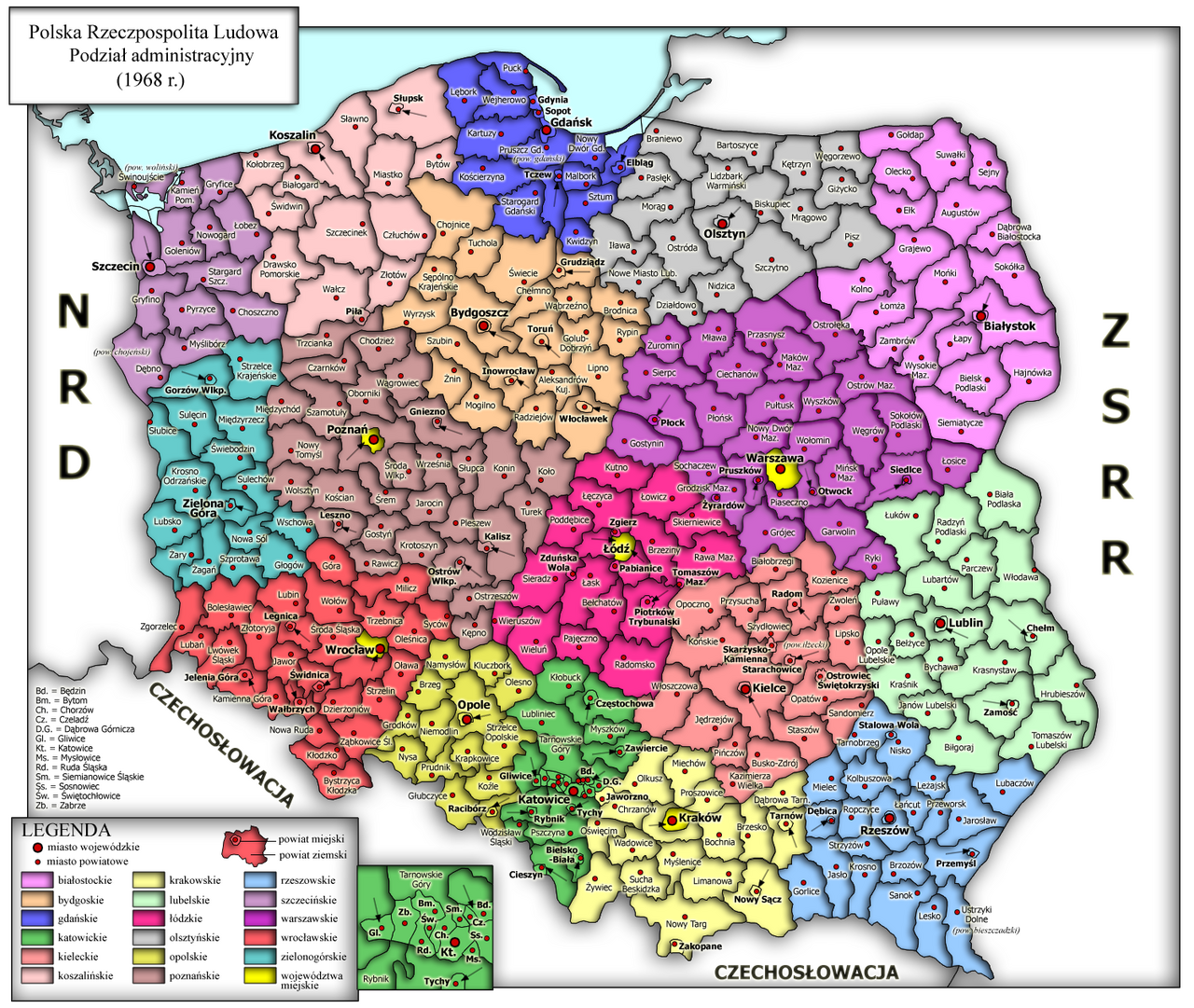
Figure 5. Administrative division of Polish territories prior to the administrative reform of 1975. Source: Wikimedia Commons, Administrative division of Poland before the 1975 reform, https://pl.wikipedia.org/wiki/ Podzia%C5%82_administracyjny_ Polski_(1944%E2%80%931975)#/media/Plik:PRL_1968_adm.png [accessed on: 14.12.2025].
In the immediate post-war period, the organisation and competences of county authorities were governed by legal provisions in force prior to 1 September 1939, subject to appropriate modifications. This situation changed fundamentally in 1950, when, under the Soviet doctrine of the so-called “uniform state authority” 16 , a new system of territorial administration was introduced. County National Councils were established as the formal legislative bodies at the county level 17 , while executive functions were exercised by their presidia. Although National Councils were nominally elected, in practice elections were purely formal. In reality, decisive influence over the composition of both the councils and their presidia, consistent with the principle of the leading role of the communist party, was exercised by the Polish United Workers’ Party 18 .
The introduction of these Bolshevik principles into the administrative structure of the state represented a radical break with the model of public administration that had evolved on Polish lands over several centuries 19 .
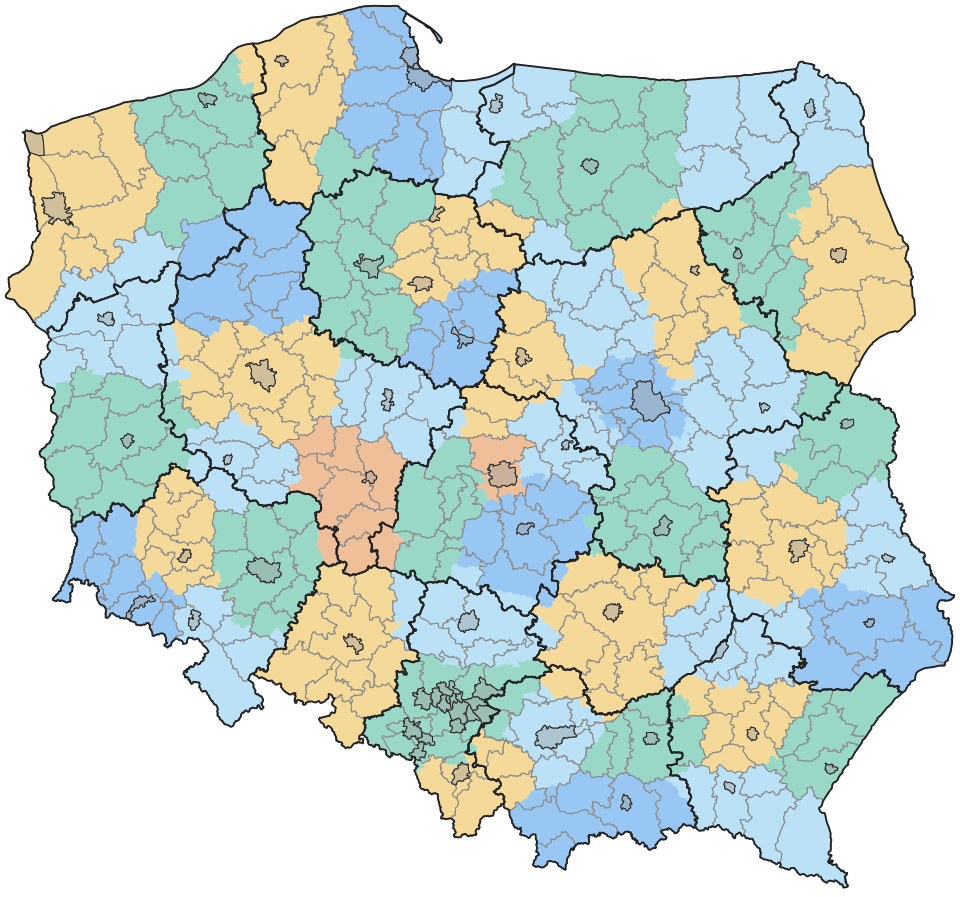
Figure 6. Administrative division of Poland since 1999, showing voivodeships and powiats. The voivodeships that existed until 1998 are marked in colour – source: Source: Wikimedia Commons, Administrative division of Poland since 1999 (voivodeships and counties), https://pl.wikipedia.org/wiki/ Reforma_administracyjna_w_Polsce_%2 819 99% 29# / med ia/ Plik:Poland_administrative_divi- sions_comparison_map_(1999_and_ pre-1999).svg [accessed on: 14.12.2025].
1 The regulations previously in force in the former Kingdom of Poland were extended to the territories of the former Russian partition. In the former Prussian partition, the office of Landrat was replaced by that of starosta, while analogous solutions were adopted in the territories of the former Austrian partition.
2 Journal of Laws of the Republic of Poland, No. 11, item 86. It should be recalled that, pursuant to the so-called August Amendment of 1926, the constitutional position of the executive authorities was substantially altered.
3 These issues are discussed in greater detail in: J. Górska-Szymczak, G. Górski, Administracja publiczna w II Rzeczypospolitej, Toruń 2021.
4 The term was understood as a specific form of legal supervision rather than hierarchical or service-based subordination.
5 Regulation of the Minister of Internal Affairs of 30 June 1930 concerning the internal organisation of county offices and the rules governing their operation. Journal of Laws of the Republic of Poland, No. 55, item 464.
6 Urban counties (powiaty miejskie) were established in the following cities: Białystok, Bydgoszcz, Częstochowa, Gdynia, Gniezno, Grudziądz, Inowrocław, Kraków, Lublin, Lviv, Łódź, Poznań, Radom, Sosnowiec, Toruń, and Vilnius.
7 In the cases of Toruń, Bydgoszcz, Inowrocław, Gniezno, Grudziądz, Poznań, Kraków, and Lviv, certain responsibilities within the scope of general governmental administration were entrusted to the presidents (mayors) of these cities, while the remaining tasks continued to be carried out by the starosts of the surrounding rural counties (powiaty ziemskie).
8 Regulation of the Minister of Internal Affairs of 3 September 1932. Journal of Laws of the Republic of Poland, No. 95, item 823.
9 Act of 23 March 1933 on the partial reform of the system of territorial self-government. Journal of Laws of the Republic of Poland, No. 35, item 294.
10 For a more detailed discussion of this issue, see: J. Górska-Szymczak, G. Górski, Administracja publiczna II RP.
11 The western voivodeships were incorporated, in whole or in part, into the German Reich by means of unlawful German decrees. Similarly, on the basis of unlawful decisions taken by the Soviet authorities, all or parts of the eastern voivodeships were incorporated into the USSR. By contrast, in the central voivodeships the German authorities, acting in violation of international law, established a protectorate-type para-state entity known as the General Government.
12 This issue, together with its constitutional and legal dimensions, is examined in detail in G. Górski, Polonia Restituta. Ustrój Państwa Polskiego w XX wieku,
Toruń 2018.
13 The conference of the victorious powers in the Second World War was held from 17 July to 2 August 1945. One of its key stipulations was the establishment of the Oder–Neisse line (the Oder and Lusatian Neisse rivers) as the provisional border between Poland and Germany.
14 Act of 28 June 1950 on changes to the administrative division of the state. Journal of Laws 1950, no. 28, item 255.
15 Decree of 31 December 1956 on the separation of the cities of Kraków, Poznań, and Wrocław from voivodeships and on granting their municipal national councils the powers of voivodeship national councils. Journal of Laws 1957, no. 1, item 1.
16 For a detailed discussion, see: G. Górski, Wokół genezy PRL, Lublin 2004.
17 Act of 20 March 1950 on territorial organs of the unified state authority. Journal of Laws 1950, no. 14, item 130.
18 For a broader discussion, see: G. Górski, Historia administracji…
19 A broader analysis of this issue is presented in G. Górski, Polonia Restituta…
Udostępnij